
“99% purity” is one of the most recognizable claims you’ll see when shopping for research peptides. It’s also one of the easiest numbers to misunderstand.
Purity can provide useful information about a research material, but it doesn’t tell the entire story. Understanding how that number was generated, what analytical method was used, and what other information is available can provide a much clearer picture of a product.
Here’s what researchers should know.
What does peptide purity actually mean?
When a research product lists a purity percentage, that number is generally based on an analytical test performed on a sample. One commonly used technique is High-Performance Liquid Chromatography, or HPLC.
HPLC separates components within a sample based on how they interact with the chromatography system. The resulting data can help analysts evaluate the relative amount of the primary component compared with other components detected under the conditions of the test.
That can be extremely useful. But it is important to understand what the result does and doesn’t tell you.
What HPLC can tell you
Think of HPLC as a way of separating a mixture so its components can be examined more clearly.
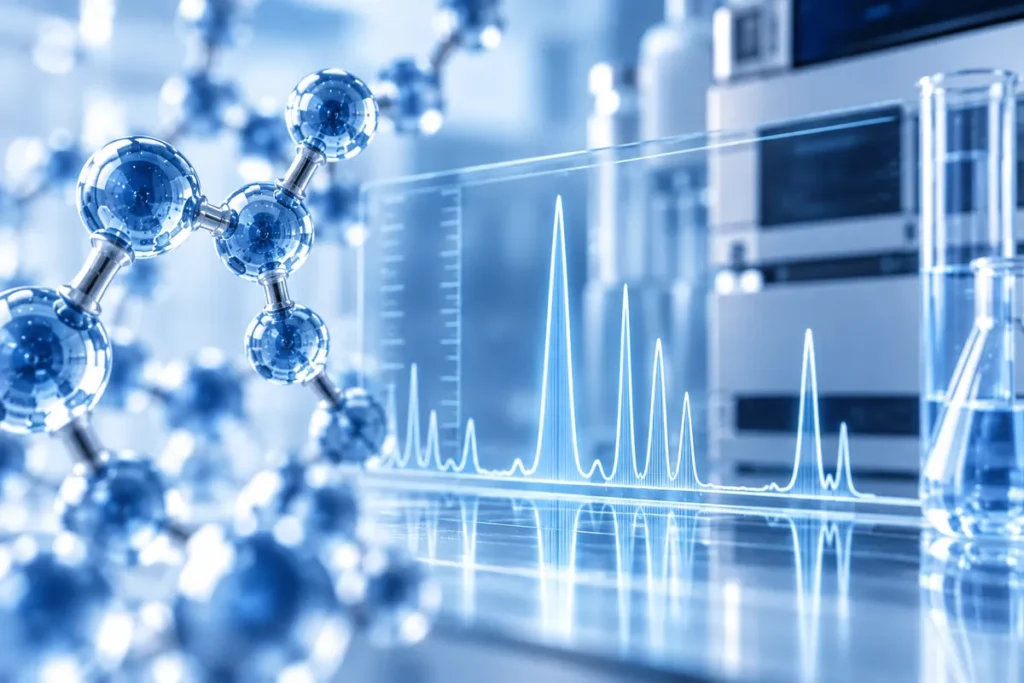
As material moves through the chromatography system, different components may appear at different retention times. The instrument records these signals and produces a chromatogram containing peaks.
The primary compound may produce a dominant peak, while other detected components may produce smaller peaks. Analysts can use that information to evaluate the relative purity of a sample.
This is where a purity value such as “99% by HPLC” may originate.
Purity and identity aren’t the same thing
This distinction is particularly important.
Purity asks how much of the detected sample appears to be the primary component. Identity asks whether that component is actually the material it’s supposed to be.
Those are related questions, but they aren’t identical.
A sample could theoretically produce a very clean chromatographic result without that result alone establishing every aspect of molecular identity. That’s why additional analytical techniques may be used when characterizing research materials.
Where mass spectrometry fits in
Mass spectrometry is another analytical technique commonly encountered in laboratory research.
Rather than separating components based primarily on chromatographic behavior, mass spectrometry measures ions according to their mass-to-charge ratio. That information can help researchers characterize a compound and may be used as part of confirming molecular identity.
HPLC and mass spectrometry therefore provide different types of information. One can help evaluate relative purity. Another can provide information relevant to molecular identity.
Together with other product specifications, they can create a more complete analytical picture.
Why context matters
It’s tempting to reduce product quality to one number. 99% sounds better than 98%. 99.5% sounds better than 99%.
But analytical results aren’t always that simple. Testing methodology, sample preparation, equipment, analytical conditions, and interpretation can all influence the information produced by an analysis.
This doesn’t make purity numbers meaningless. It means they should be understood in context.
Instead of asking only “what’s the purity?”, a more useful set of questions might be:
- What method was used?
- Was identity evaluated?
- What product specifications are available?
- Is there analytical documentation available for this material?
Those questions tell you considerably more.
What about Certificates of Analysis?
A Certificate of Analysis, commonly called a COA, is a document used to summarize analytical information associated with a product, sample, lot, or batch. The exact information included can vary.
Depending on the material and testing performed, a COA may include information such as product identification, lot or batch information, analytical method, purity results, identity-related information, or other specifications.
It’s important not to assume every COA contains the same testing or provides the same level of information. The value of the document comes from understanding what was actually analyzed and what the reported results represent.
Testing is only one part of product quality
Analytical testing is important, but it doesn’t exist in a vacuum. Consider everything that happens before and after a sample reaches an analytical instrument.
The material has to be sourced. Specifications have to be established. The product has to be packaged. Storage conditions need to be considered. Product information needs to be communicated accurately.
That’s why we prefer to look at research-product quality as a complete system rather than a single test result.
Source. Test. Package. Store. Document. Each step provides another piece of the picture.
Look beyond the label
A purity number can be useful. It just shouldn’t be the end of the conversation.
Understanding the analytical method, product identity, specifications, documentation, packaging, and storage requirements provides far more context than a percentage alone.
At Amino Connection, our goal is to make it easier to understand the information behind the products you order, because researchers shouldn’t have to rely solely on what’s printed in large type on the front of a vial.